
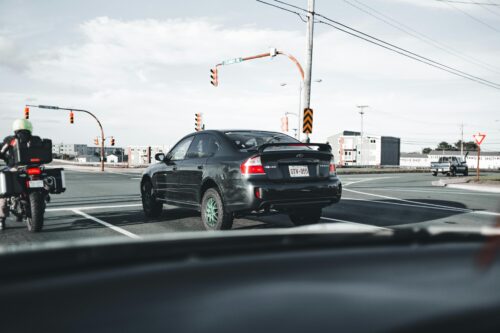
T-bone accidents can have devastating consequences, physically, emotionally, and financially. Determining liability in any auto accident is crucial, but California’s tort laws make it even more important. If you were involved in a T-bone accident, understanding who can be held at fault is imperative to protect your right to compensation. In many side-impact collisions throughout Northern California, including San Mateo County, the at-fault driver may fail to yield, run red lights or stop signs, or may be distracted. Unfortunately, however, liability is not always straightforward. Keep reading for more information and consult with a knowledgeable San Mateo County, California car accident lawyer to secure the help of a legal professional.
What Is a T-Bone Accident and How Do They Occur?
A T-bone accident, also called a side impact collision, happens when one vehicle crashes into the side of another, creating what looks like a “T.” These incidents most commonly occur at intersections but can also happen in parking lots or while pulling in or out of a driveway.
T-bone accidents are extremely dangerous because the sides of vehicles do not offer as much protection as the front or rear. Occupants closest to the impact do not have a lot of space and will absorb the force of the crash. Serious injuries can occur even at moderate speeds.
Common Causes of T-Bone Accidents in California
- Running a red light or stop sign
- Failure to yield while turning left
- Distracted driving
- Drunk driving
- Speeding through intersections
- Unsafe driving during wet weather conditions
Unfortunately, T-bone accidents are common at intersections controlled by traffic lights and other signals. In Northern California, these collisions are common on high-traffic roads, including Highway 101, I-280, El Camino Real, and other intersections throughout San Mateo County and the surrounding communities.
Why Side-Impact Collisions Are So Dangerous
- Vehicle sides and doors have less structural protection
- Occupants near the impact point are at an increased risk of injury
- Side-impact crashes can result in serious injuries like TBIs, internal bleeding, and spinal injuries
- High-speed T-bone collisions can push vehicles into oncoming traffic, resulting in additional collisions
Who Is At-Fault for a T-Bone Accident in CA?
Determining fault in a T-bone accident in California is an essential step toward recovering damages. While it often appears that the driver who struck the side of the other vehicle is at fault, that is not always the case. A thorough investigation may reveal that the fault is shared or lies with a third party entirely.
California is a fault-based accident state, which means the party or parties responsible for the collision can face financial liability for the damages and injuries suffered.
Potentially Liable Parties
- A negligent driver: The most common at-fault party is the driver who failed to yield the right-of-way, ran a red light or stop sign, was distracted, speeding, or driving under the influence. Even the driver who was struck may be somewhat at fault if they were speeding, failed to signal, or contributed to the accident in any way.
- A vehicle manufacturer: If the accident was caused or worsened by a vehicle defect, such as brake failure, faulty airbags, or steering issues, the manufacturer could be held liable under product liability laws.
- A repair or maintenance shop: A mechanic or repair shop can be held liable if their negligent work directly led to the accident.
- A government agency: A city, county, or state agency may be at fault if the collision was caused by dangerous road conditions, improperly maintained traffic signals, or poorly designed intersections.
While it is easy to assume that the driver who struck the side of the other vehicle is automatically or entirely responsible, it is not always so straightforward.
How Does Comparative Negligence Impact a San Mateo T-Bone Accident Case?
California uses a pure comparative negligence system. This means that even if you are partially at fault for a T-bone accident, you can still recover damages. However, your compensation will be reduced by your percentage of fault.
For example, if you are 20% responsible, you can recover 80% of your total damages.
Examples of Shared Fault in a T-Bone Accident
- One driver runs a red light while the other speeds through an intersection
- A turning driver misjudges a left turn while the oncoming driver is texting
- A defect with the road conditions contributed to a collision in which another driver acted negligently
Why Comparative Negligence Matters in California
This is an important concept as it allows multiple parties to share responsibility for the resulting damages. For example, the driver who struck the other will likely be found liable, but a manufacturer whose negligence contributed could also be held accountable.
What Evidence Helps Prove Fault in a California T-Bone Crash?
When you are hurt in a side-impact collision in California, it can be an incredibly stressful and overwhelming experience. However, it’s in your best interest to remain calm and gather as much evidence at the scene as possible. Doing so is integral to ensuring you can fight for the compensation you deserve. In general, the more evidence you can gather to support your claim, the better.
Important Evidence in a T-Bone Accident Investigation
- Photos of damage to all vehicles involved
- Surveillance or dashboard camera footage
- Eyewitness testimony
- Skid marks
- Cellphone records
- Toxicology reports (if a DUI is suspected)
- Vehicle black box data
Contact an Experienced San Mateo County Accident Firm Today
If you have suffered the impacts of a T-bone collision in Northern California, you may be suffering as a result. These collisions can result not only in physical pain, but also in mounting medical bills. As such, recovering the compensation you deserve for these damages is critical, which is why working with an attorney with the Law Office of Allister R. Liao, P.C., is in your best interest. Our firm understands how difficult these matters can be to navigate, which is why we will do everything in our power to help you fight for the justice and compensation you deserve. Contact us today to learn how we can represent you.